Text briefing | Sources checked November 5, 2026
Revise an AI Plan With Recorded Task Times
Use a fictional time log to revise a draft plan, recalculate the buffer and make the tradeoff explicit.
- For
- Anyone revising a low-stakes plan after recording task times.
- Use it to
- Compare estimates with one log, re-add minutes and preserve a human decision.
A draft schedule can fit its estimates and still need revision after the work. Compare the time you recorded with the original estimate, recalculate the next plan, and let a person decide what to defer.
This is a constructed teaching case. The bookshelf tasks, time log, unchecked AI-style draft, and revised options below are fictional. No person performed this work, no model produced the sample draft, and no AI time saving or performance result was measured.
Start with the old plan and a new log
In the previous lesson, a fictional community bookshelf setup had a 35-minute window. Inventory was estimated at 8 minutes, sorting at 12, and labeling at 10, in that order. Five minutes were protected as an interruption buffer, so the estimates filled the window: 8 + 12 + 10 + 5 = 35. An optional 15-minute poster was deferred.
Now imagine a fictional completed trial. This invented log records elapsed time for the three required steps:
| Required task | Old estimate | Fictional logged time | Difference |
|---|---|---|---|
| Inventory first | 8 minutes | 9 minutes | 1 minute longer |
| Sort after inventory | 12 minutes | 14 minutes | 2 minutes longer |
| Label after sorting | 10 minutes | 11 minutes | 1 minute longer |
| Required total | 30 minutes | 34 minutes | 4 minutes longer |
The fictional trial used 34 of the 35 minutes, leaving one minute. The original five-minute buffer absorbed four minutes of overrun. That is a description of this constructed log, not proof that the next attempt will take 34 minutes.
Catch a stale revision
Here is an unchecked AI-style draft that we constructed for teaching; it is not a captured model response:
Next window: inventory 8 minutes, sort 12, label 10, and keep a 5-minute buffer. Everything fits in 35 minutes.
Its arithmetic matches the old estimates. It ignores the new log. The specific error is not that 8 + 12 + 10 + 5 was added incorrectly. The error is using outdated inputs while presenting the result as the next plan. This is why an orderly table is not enough: check which version of the facts it used.
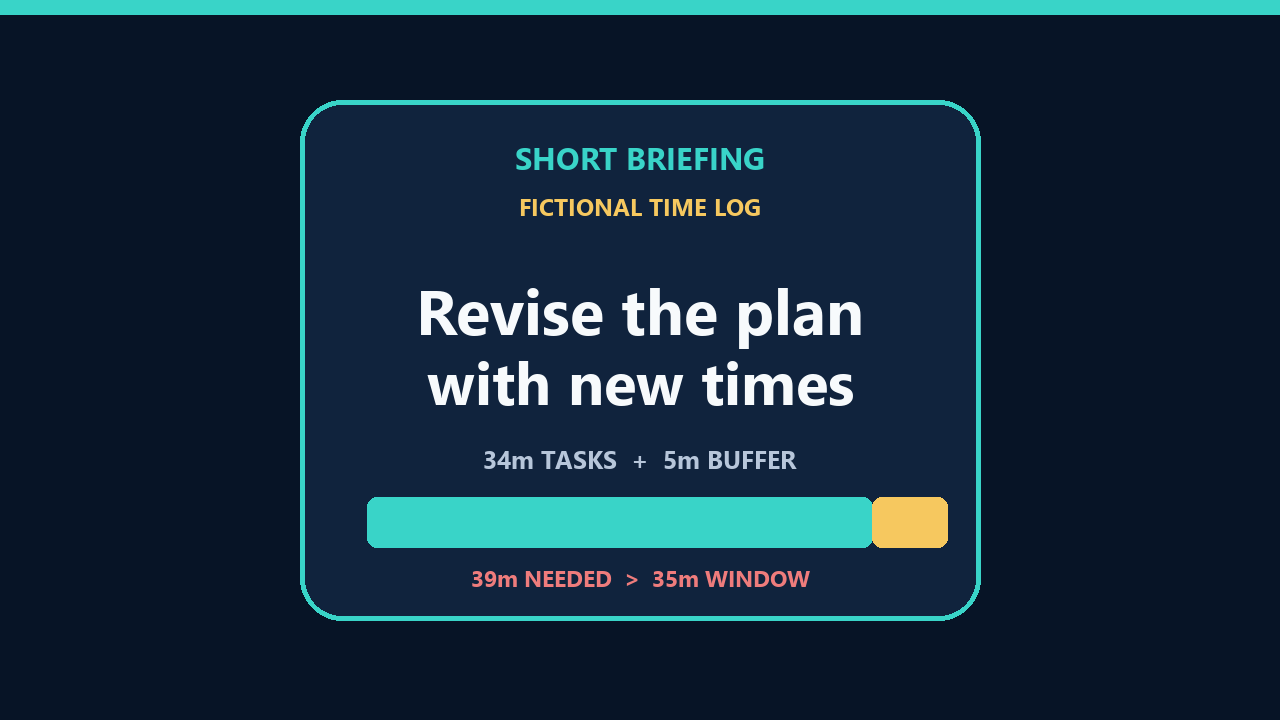
If we use the logged durations as one planning reference, the required tasks total 9 + 14 + 11 = 34 minutes. Keeping the same five-minute buffer would require 34 + 5 = 39 minutes, four more than the 35-minute window. A 35-minute plan with all three tasks would leave only one minute unassigned. It cannot also claim to protect five.
The log is one observation, not a precise forecast. A real task can vary because of setup, interruptions, the person doing it, or a changed scope. The next plan needs both the numbers and a human choice about acceptable slack.
Ask AI for options, then check them yourself
Give your AI tool the old plan, the log, the fixed window, the required order, and the buffer. Ask it to show the differences and offer options without silently changing a constraint. OpenAI's planning guide recommends starting with the decision, adding timeline and capacity constraints, and treating an AI plan as a draft to reality-check. Its prompting guide recommends clear context and review. Neither source validates these fictional durations.
Copy-Paste Verification Rule
Use my logged times as one observation, not a guarantee.
Show the old estimate, logged time, and difference for each task.
Add the logged task times and my protected buffer; compare with my fixed window.
Preserve task order and ask me whether to defer work or extend the window.
Mark any missing duration unknown; do not invent it.
Inputs: [paste task list, estimates, log, required order, window, and buffer].
For this case, two constructed options are worth comparing:
- Keep the 35-minute window and the five-minute buffer. Inventory and sorting use 9 + 14 = 23 minutes. With the buffer, that commits 28 minutes. Labeling needs another 11, so it moves to a later window. The remaining seven minutes are not permission to pretend the 11-minute task fits while preserving the buffer.
- Keep all three required tasks in one window. The logged times add to 34 minutes. To protect five additional minutes, request a window of at least 39 minutes. The person responsible for the work must decide whether a longer window is available.
Neither option is an AI decision. The first defers a required step; the second changes the window. If labeling has a hard deadline, deferring it might be unacceptable. If the 35-minute window is fixed, extending it might be impossible. Ask the person who owns those constraints rather than allowing the draft to quietly choose.
Verify the next draft in four passes
Inputs: Does every row use the correct log and preserve its units? Here the old estimates are 8, 12, and 10; the invented logged times are 9, 14, and 11. Label which column is which.
Math: Re-add the task times and buffer without AI. Check 9 + 14 + 11 = 34 and 34 + 5 = 39. Compare 39 with 35: 39 − 35 = 4.
Order and tradeoff: Inventory still precedes sorting, which precedes labeling. A plan that defers labeling must say so; it must not mark the shelf setup complete. A plan that keeps all tasks must identify the longer window or reduced buffer as a decision requiring approval.
Uncertainty: A single log is a useful warning about stale estimates, not a guarantee for the next session. If a duration was not recorded, write “unknown.” If the task changed, a past time may not be comparable. OpenAI's accuracy guidance warns that confident answers can be wrong and recommends checking important information against reliable sources. Your original notes and clock record are the sources for this task; an AI explanation is not a replacement.
Try it: Take a harmless plan you are allowed to share. Put its estimates beside a genuine, non-sensitive elapsed-time log, or use clearly labeled fictional data for practice. Ask AI for a revised draft using the rule above. Recalculate the total and point to the human decision before using the plan.
Sources checked November 5, 2026: OpenAI Academy, Brainstorming with ChatGPT (dated April 10, 2026); OpenAI Help, Prompt engineering best practices for ChatGPT (page displayed “Updated: 17 days ago”); OpenAI Help, Does ChatGPT tell the truth? (page displayed “Updated: 14 days ago”). These pages support the prompt-and-check method, not this fictional log or any measured benefit.
One step you can use
Use the log, then choose.
On a harmless plan you may share, give AI the old estimates and an actual non-sensitive log. Re-add the minutes yourself and have the responsible person choose the tradeoff.
Limits
One time log is not a forecast. Changed scope, interruptions and the person doing the work may change the next duration.
Disclosures
AI assisted research and drafting. The bookshelf, time log, unchecked AI-style draft and revised options are constructed teaching examples. No model produced the sample draft, and no real task time or AI benefit was measured. The companion video uses synthetic narration and original project graphics.
Corrections
No corrections have been recorded. See the corrections process.