Text briefing | Sources checked November 3, 2026
Make an AI Plan Fit the Time You Actually Have
Give an AI planning draft a time limit, then check what fits and what must wait.
- For
- Anyone planning a short window of low-stakes tasks.
- Use it to
- Check required steps, task order, time arithmetic, buffer and optional work.
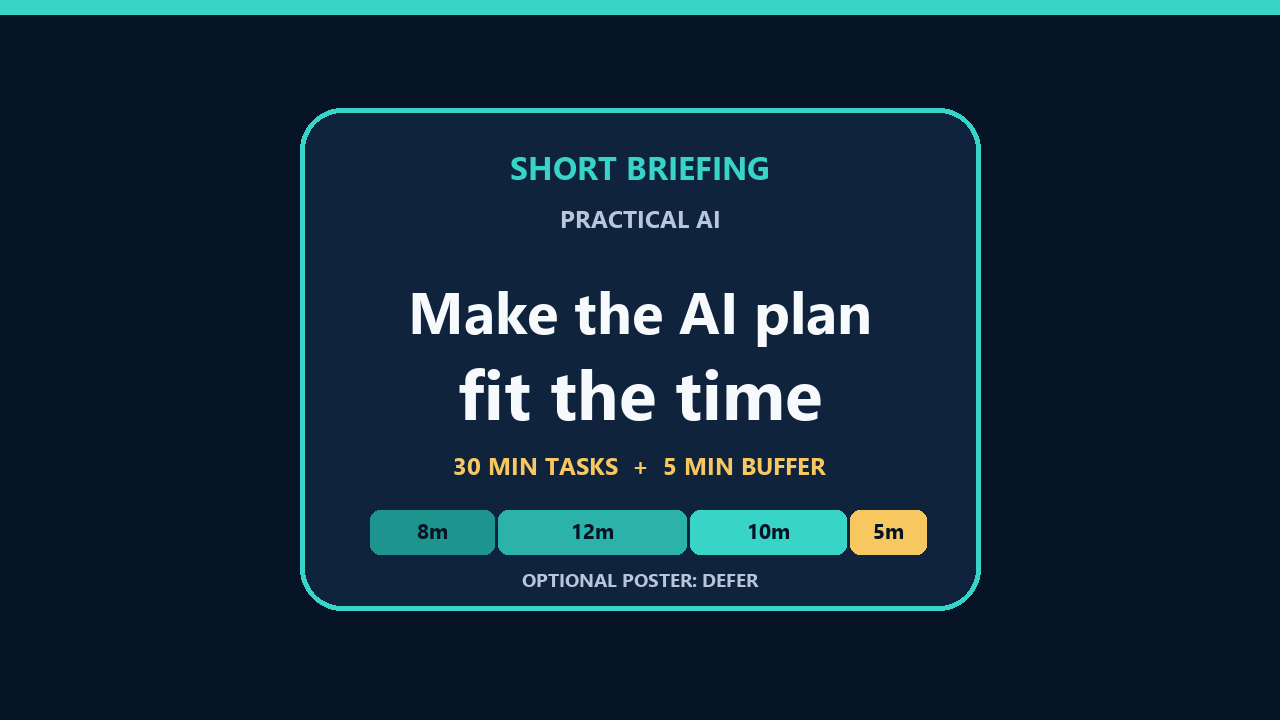
An AI-generated plan can look orderly while quietly spending more minutes than you have. Give the model the time limit, the task order, and the work you may defer. Then check its arithmetic yourself before you act.
For: Someone turning a short list of low-stakes tasks into a realistic first-pass schedule.
Use it to: See which tasks fit, which do not, and what assumption needs a human decision.
Start with capacity, not a polished timetable
OpenAI Academy's brainstorming guide recommends starting with the decision, giving the model constraints such as timeline and capacity, and reality-checking the draft plan. OpenAI's prompting guidance similarly recommends clear context and reviewing the response. Neither guide says an AI timetable proves the work will finish on time. OpenAI's accuracy guidance warns that a confident answer can still be wrong.
Here the decision is narrow: What fits into one 35-minute window while protecting five minutes for interruption? We will use an entirely fictional community bookshelf setup. Every task, duration, rule, and output below is a teaching illustration. No team performed the work, no separate model was tested for this example, and no time saving was measured.
The fictional source card says:
| ID | Supplied planning fact |
|---|---|
| S1 | The available work window is 35 minutes. Do not plan beyond it. |
| S2 | Inventory the books first; estimate 8 minutes. |
| S3 | Sort the books after inventory; estimate 12 minutes. |
| S4 | Label the sorted shelves last; estimate 10 minutes. |
| S5 | A poster is optional and estimated at 15 minutes. Reserve five minutes for interruptions before considering optional work. |
These are invented estimates, not observed task times. Inventory, sort, and label form a dependency chain. A plan that labels before sorting violates the supplied order even if its total is 35.
Give AI a bounded planning job
Use a prompt that makes the constraints visible and permits the answer “does not fit.” Replace the bracketed fields with information you may share with your AI tool:
I have [total minutes] for [goal]. Use only the task names, estimates, dependencies, and priority labels I supply below. Make a draft schedule with start and end offsets in minutes. Keep required tasks in dependency order and reserve [buffer minutes] as unassigned time. Show the sum of required estimates and buffer separately from optional work. If an optional task does not fit, mark it deferred; do not shorten an estimate, overlap dependent tasks, remove the buffer, or extend the window to make the table look complete. Flag missing facts or conflicting constraints as questions for me. These times are estimates, not a promise that work will finish. After the table, show the arithmetic I should verify myself.
Goal: [goal]. Window: [minutes]. Required tasks in order: [task, estimate, dependency]. Optional tasks: [task and estimate]. Buffer: [minutes].
For the fictional shelf case, a constructed example of a possible draft table would be:
| Offset from start | Draft activity | Why it belongs there |
|---|---|---|
| 0–8 minutes | Inventory books | Required first; estimated 8 minutes. |
| 8–20 minutes | Sort books | Starts after inventory; estimated 12 minutes. |
| 20–30 minutes | Label shelves | Starts after sorting; estimated 10 minutes. |
| 30–35 minutes | Unassigned buffer | Protects five minutes; not another task. |
| Deferred | Make poster | Optional 15 minutes; no room in this window. |
This table is constructed for explanation, not an observed AI response. The prompt is reusable, but an actual AI answer still needs checking.
Do the time check without AI
Add the three required estimates yourself: 8 + 12 + 10 = 30 minutes. The buffer brings the planned commitment to 30 + 5 = 35 minutes, exactly the available window. Check the boundaries too: 8 − 0 = 8, 20 − 8 = 12, 30 − 20 = 10, and 35 − 30 = 5. No dependent tasks overlap.
If you added the optional poster to the required work, the task estimates alone would be 30 + 15 = 45 minutes, 10 minutes beyond the 35-minute window. If you also kept the five-minute buffer, the total would be 50 minutes, 15 minutes beyond the window. Calling the poster “quick” or silently reducing its estimate would hide the conflict, not solve it.
The schedule passes this arithmetic and dependency check. That does not mean the invented estimates are accurate or the work will happen exactly on those offsets. If inventory runs long, the buffer can absorb at most five minutes of combined overrun before the plan exceeds the window. A real organizer decides what to defer or reschedule; the model does not create more time.
Audit the answer before you use it
Check four things against your own task list:
- Every required item is present. An attractive table may omit the least pleasant step.
- The order is possible. Here, sorting follows inventory, and labeling follows sorting.
- Each duration and boundary matches the input. Recalculate the sum and each start/end interval without relying on the AI's explanation.
- The tradeoff is explicit. The poster is deferred; the five-minute buffer remains unassigned.
If one duration is unknown, ask for an estimate from the person doing the work or label it unknown. Do not let the model invent a precise number and then treat it as a commitment. If the list contains a fixed opening time, travel, a handoff, or a safety rule, add that constraint and check it separately. This small example does not account for setup, accessibility needs, interruptions longer than five minutes, or multiple people working in parallel.
Try it: Pick a harmless task list you are allowed to share. Mark required and optional work, note any order constraints, set a time window and a buffer, and ask AI for a draft using the prompt above. Re-add the minutes and inspect the order yourself. If the total does not fit, decide what to defer before the work begins.
Sources checked November 3, 2026: OpenAI Academy, Brainstorming with ChatGPT (April 10, 2026); OpenAI Help, Prompt engineering best practices for ChatGPT (page displayed “Updated: 15 days ago”); OpenAI Help, Does ChatGPT tell the truth? (page displayed “Updated: 12 days ago”). These sources support the prompting and checking method, not the fictional shelf setup or its estimated durations.
One step you can use
Check the minutes before you act.
On a harmless task list you may share, ask AI for a first-pass plan with your real limit and order. Re-add the minutes yourself and make any deferral explicit.
Limits
A schedule can fit supplied estimates without proving the estimates are right. Real work may need travel, handoffs, accessibility needs, safety checks or a larger interruption buffer.
Disclosures
AI assisted research and drafting. The community bookshelf, task estimates and possible plan are constructed teaching illustrations. No separate AI prompt run, real setup, measured time saving or guaranteed result is claimed. The companion video uses synthetic narration and original project graphics.
Corrections
No corrections have been recorded. See the corrections process.