Text briefing | Sources checked October 28, 2026
Use AI to Draft a Status Update Without Claiming Work Is Done
Use AI to draft a short update without converting a request, agreement, or open task into completed work.
- For
- Anyone preparing an update from a verified, non-sensitive action list.
- Use it to
- Separate what is done, what comes next, and what remains blocked.
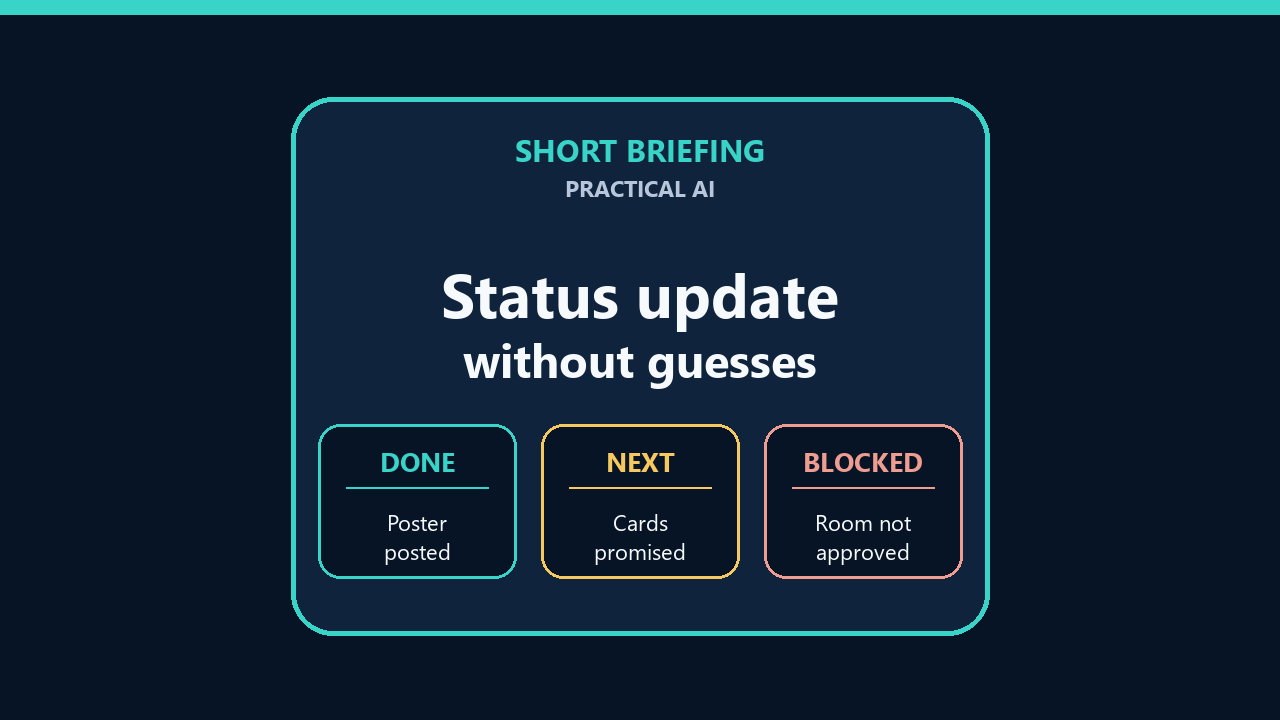
A short update can change the facts if it turns “asked” into “approved” or “agreed to bring” into “delivered.” AI can help turn an action list into readable prose, but the person sharing it still needs to check every claim against the source.
Use three labels: Done for completed steps, Next for agreed future work or an unassigned action to decide, and Blocked for an outcome waiting on a condition or approval. A step can be done while its larger outcome remains blocked. Sending a room request is done; getting the room is not.
A fictional art-table note
This community art-table example, its people, and both drafts below are constructed for teaching. They are not a record of a real event or an observed response from a separate AI run.
Planning note — Wednesday, October 28, 2026
1. “The art-table poster was approved and posted.”
2. “Nico agreed to bring 10 blank cards on Saturday, October 31. Delivery has not been confirmed.”
3. “A room request was sent. Approval has not arrived, so the room is not booked.”
4. “Jo has not been asked about scissors. No one is assigned to ask Jo.”
October 31, 2026 is a Saturday. The date and quantity belong only to the fictional note.
A fluent but constructed faulty draft might say: “The poster is up, Nico delivered 10 cards, the room is booked, and Jo is bringing scissors.” Only the poster claim survives comparison with the note. The other three claims add delivery, approval, and an assignment that the source explicitly does not establish.
Keep the status attached to the evidence
| Source line | Supported status | Claim to avoid |
|---|---|---|
| 1. Poster approved and posted. | Done: the poster is posted. | No extra approval or attendance claim follows. |
| 2. Nico agreed to bring 10 blank cards on Saturday, October 31; delivery unconfirmed. | Next: Nico agreed to bring them; confirm delivery later. | “The cards arrived.” |
| 3. Room request sent; approval absent; room not booked. | Done: the request was sent. Blocked: announcing a booked room awaits approval. | “The room is booked.” |
| 4. Jo not asked; nobody assigned to ask. | Next: assign someone to ask Jo. | “Jo will bring scissors.” |
Here is a corrected illustrative update, written from those four lines:
Done: The art-table poster was approved and posted. A room request was sent, but approval has not arrived.
Next: Nico agreed to bring 10 blank cards on Saturday, October 31; delivery is unconfirmed. Someone still needs to be assigned to ask Jo about scissors.
Blocked: The room is not booked. Do not announce it as the location until approval is confirmed.
“Someone still needs to be assigned” describes the gap; it does not assign a person. “Do not announce it” is a recommendation for this constructed example, not a quotation from the note. The other factual sentences can each be traced to a numbered line.
A reusable prompt
Paste only a harmless action list or material you are authorized to share with the AI service:
Using only the verified action list below, draft a status update of no more than 80 words under Done, Next, and Blocked. Put a step under Done only if the source says it happened. Keep an agreement about future work separate from delivery or completion. Preserve exact people, quantities, dates, and approval conditions. If an owner, delivery, or approval is unknown, say so; do not fill it in. After the update, list each factual sentence with the exact source line that supports it. Mark any sentence without support cannot verify. Do not send the update or contact anyone.
VERIFIED ACTION LIST: [paste a non-sensitive list you are authorized to use]
Read the source-to-sentence list before you use the prose. For each sentence, ask: Did this happen, is it agreed future work, or is it waiting? Then check the exact person, number, date, and approval status. If the sentence silently changes “request sent” to “approved,” correct it. If no source line supports a statement, remove it or mark it for confirmation.
OpenAI’s prompt guidance recommends a clear task, necessary context, a desired format, and iteration. OpenAI’s accuracy guidance warns that a confident answer can still be wrong and recommends verifying important information. NIST’s AI Risk Management Framework describes objective evidence and human oversight in the context of trustworthy AI. These sources support checking the draft; none evaluates this fictional note, measures this prompt’s success, or guarantees that a checked update is current.
Even a sentence faithful to old notes can be outdated. Before sharing a real update, check that the action list is current and that any consequential owner, completion, or approval has been confirmed by the responsible person. Do not put private messages, workplace records, or personal details into an AI tool unless you are authorized to use that tool for those records.
Try it: Take one harmless verified action list, ask for a Done / Next / Blocked update, and trace each factual sentence to its source before sharing it.
Sources and disclosure
- OpenAI, “How do I create a good prompt for an AI model?”, checked October 28, 2026. The page displayed “Updated: 8 days ago”; no absolute update date was displayed.
- OpenAI, “Does ChatGPT tell the truth?”, checked October 28, 2026. The page displayed “Updated: 5 days ago”; no absolute update date was displayed.
- NIST AI Risk Management Framework 1.0, section 3, “AI Risks and Trustworthiness”, 2023 excerpt, checked October 28, 2026. NIST says a revision is in progress.
Disclosure: AI assisted research and drafting. Short Briefing constructed and checked the fictional note, faulty draft, and corrected example, and reviewed the source claims. No separate model run, real art-table event, measured benefit, or subscriber outcome is claimed. Any companion video uses synthetic narration and original project graphics.
One step you can use
Trace every sentence to the action list.
Check the person, quantity, date, and approval before sharing an AI-assisted update.
Limits
A faithful update can still be outdated. Confirm the current status with the responsible person before consequential use.
Disclosures
AI assisted research and drafting. Short Briefing constructed and checked the fictional art-table example and illustrative drafts. No separate model run, real event, measured gain, or subscriber outcome is claimed. Any companion video uses synthetic narration and original project graphics.
Corrections
No corrections have been recorded. See the corrections process.