Text briefing | Sources checked October 24, 2026
How to Handle Conflicting Notes Before Asking AI to Draft
A polished AI draft can hide a disagreement in its notes. Compare the evidence before asking for public copy.
- For
- Anyone combining working notes into a message with AI.
- Use it to
- Catch conflicting details and ask the responsible person to resolve them.
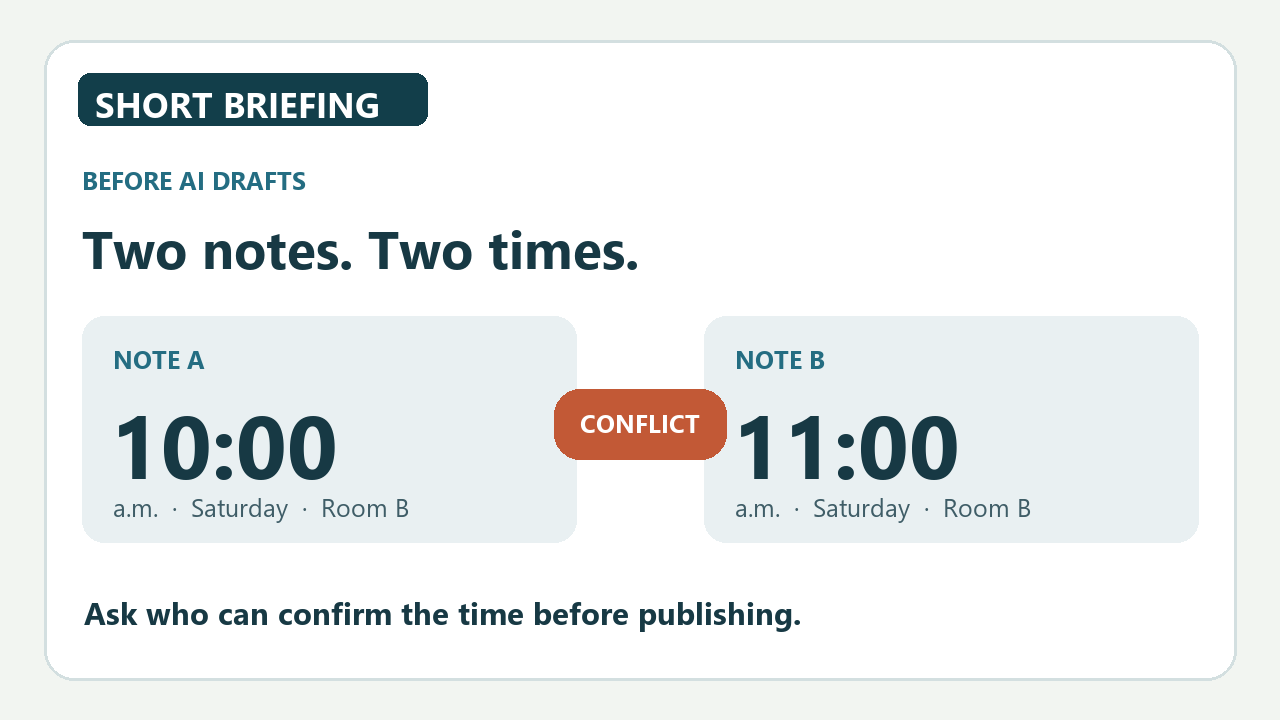
A tidy AI draft can hide a disagreement in its source notes. One note says a workshop starts at 10:00 a.m.; another says 11:00 a.m. A polished announcement with either time would look complete, but the source owner has not settled the difference. The useful first task for AI is to show the conflict, not write the announcement.
Two notes about one fictional workshop
These are invented working notes for a paper-flower workshop. There is no real event or registration link.
Note A — working schedule note: Paper-flower workshop, Saturday, Room B. Start time: 10:00 a.m. Registration link not final.
Note B — working flyer copy: Paper-flower workshop, Saturday, Room B. Start time: 11:00 a.m. Registration link not final.
Both notes name the same activity, day, and room. They give different start times. They also agree that the registration link is not final. Neither note says it is approved. Do not silently prefer the flyer because it looks more polished, or the schedule because it sounds official. The person responsible for the event must confirm which time to use.
Yesterday's lesson showed how to give AI a task, context, and check. Here the task changes: compare the source notes before asking for public copy. The context is the two labeled notes and their working status. The check is whether the comparison preserves their agreement, disagreement, and unresolved link. This is different from an unknown value: both times are present, and they contradict each other.
A prompt you can adapt
These are two fictional working notes about the same paper-flower workshop. Compare them before drafting any public announcement. Make a table with each detail, what Note A says, what Note B says, and whether they agree, conflict, or remain unresolved. Do not choose a winner because one note is newer or better formatted. After the table, write one question for the organizer about what must be confirmed. Do not invent or publish a start time or registration link.
Note A: Paper-flower workshop, Saturday, Room B. Start time: 10:00 a.m. Registration link not final.
Note B: Paper-flower workshop, Saturday, Room B. Start time: 11:00 a.m. Registration link not final.
We constructed the following illustrative response for this lesson. It is an example of what to inspect, not an observed output from a separate model run.
| Detail | Note A | Note B | Check |
|---|---|---|---|
| Activity, day, room | Paper-flower workshop; Saturday; Room B | Same | Agreed in both notes |
| Start time | 10:00 a.m. | 11:00 a.m. | Conflict — ask the organizer |
| Registration link | Not final | Not final | Unresolved — wait for the final link |
Question for the organizer: “Which start time is approved for the Saturday paper-flower workshop in Room B, and is the registration link ready for public use?”
The table earns its place only if you check it against the notes. Read each row back to the originals. “Saturday” and “Room B” appear in both. The two times differ. “Not final” is not the same as “no registration,” and it is not permission to invent a link. If AI says the 11:00 a.m. note is correct because it is the flyer, that is an inference the source material does not authorize.
What happens after the question
Keep the public announcement on hold. Ask the organizer to identify the approved source or provide a corrected one. Once the time and link are confirmed, update the source notes, request the draft, and check every event detail against that approved record. A model can help expose a discrepancy; it cannot decide who has authority to resolve it.
This deliberately small example is easy to inspect. Real files may discuss different event dates, use outdated versions, or disagree on subtler points. First verify that the records refer to the same thing. AI can also miss a contradiction even when asked to find one, so use the table as a review aid and inspect important source lines yourself. For consequential public information, the responsible human should approve the facts.
One step to try: Before giving AI two notes to turn into a message, ask for an agreed / conflict / unresolved table. Check one row yourself, and resolve every conflict with the source owner before sharing a draft.
Sources and limits
- OpenAI: Prompt engineering best practices for ChatGPT, checked October 24, 2026. Supports clear requests, context, and reviewing responses; does not validate this example.
- OpenAI: Does ChatGPT tell the truth?, checked October 24, 2026. Supports checking important claims because plausible AI answers can be wrong; does not measure this method.
- Anthropic: Reduce hallucinations, checked October 24, 2026. Recommends making uncertainty visible and grounding claims in supplied material; it does not guarantee a model will catch every conflict.
Disclosure: AI assisted research and drafting. Short Briefing constructed and checked the fictional notes, illustrative response, and final wording. Any companion video uses synthetic narration and original project graphics. No real workshop was checked or announced.
One step you can use
Ask AI for an agreed / conflict / unresolved table before it drafts from multiple notes.
Check each row against the originals. Resolve conflicting facts with the source owner before sharing public copy.
Limits
This fictional teaching example is not a live model test. AI may miss a conflict; verify important source lines yourself.
Disclosures
AI assisted research and drafting. Short Briefing constructed and checked the fictional notes and illustrative response. The companion video uses synthetic narration and original project graphics.
Corrections
No corrections have been recorded. See the corrections process.